


GLP-1 Drug Injury Lawyer for Wernicke’s Encephalopathy
Representing Ozempic, Mounjaro & Zepbound Victims
Can Ozempic Cause Brain Problems?
Ozempic and other GLP-1 drugs can cause brain problems indirectly, through severe nutritional deficiency rather than through any direct toxic effect on brain tissue. The drug suppresses appetite and slows digestion so effectively that some patients stop taking in enough thiamine, and thiamine is the vitamin brain cells depend on to convert food into usable energy. When thiamine runs out, specific regions of the brain begin to fail.
The distinction matters medically and legally. A GLP-1 patient who becomes suddenly confused, develops double vision or cannot walk steadily is not experiencing a psychiatric side effect or ordinary fatigue. Those three signs together point to Wernicke’s encephalopathy, a thiamine-deficiency emergency that is treatable with high-dose intravenous thiamine and permanent once the window closes.
Families frequently describe the change before any physician records it. A relative who was managing normally two weeks earlier becomes confused, repeats questions, or cannot be left alone. If that describes someone on a GLP-1 drug, the possibility of thiamine deficiency belongs in front of a doctor immediately, and the timeline of when it was raised becomes central to any later claim.
Millions of Americans now take a GLP-1 drug, such as Ozempic®, Wegovy®, Mounjaro®, or Zepbound®, to manage type 2 diabetes or lose weight. For most people, these medications work as intended and carry no lasting complications. But a growing body of medical case reports, FDA adverse-event data, and now federal litigation points to a serious, if uncommon, complication tied to this entire drug class: Wernicke’s encephalopathy, a brain condition caused by severe thiamine (vitamin B1) deficiency.
If you or a loved one experienced sudden confusion, vision changes, or a loss of coordination while taking a GLP-1 drug, the connection may not be a coincidence, and you may have legal options worth understanding.
What is Wernicke’s Encephalopathy and How is It Linked to GLP-1 Drugs?
Wernicke’s encephalopathy, sometimes referred to alongside Wernicke-Korsakoff syndrome, is a medical emergency caused by a severe shortage of thiamine (vitamin B1), often linked to malnutrition. Thiamine helps your brain convert food into usable energy, and without enough of it, cells in specific regions of the brain begin to break down in as little as two to three weeks.
Most people associate Wernicke’s encephalopathy with alcohol use disorder, and that’s still its most common cause. But research published in Mayo Clinic Proceedings confirms the condition can develop in anyone with a significant nutritional deficiency, whether from bariatric surgery, severe illness, or, increasingly, rapid weight loss on a GLP-1 drug.
The condition is also notoriously easy to miss. Physicians are traditionally taught to look for a “classic triad” of symptoms that include confusion, abnormal eye movements, and difficulty walking. That same Mayo Clinic Proceedings research found all three symptoms appear together in only about 10% of cases.
Left untreated, approximately 80% of patients go on to develop Korsakoff syndrome, according to the same study. Cleveland Clinic describes this chronic memory disorder as causing severe memory loss and confabulation, a pattern where a person unknowingly fills gaps in their memory with fabricated information.
The encouraging news is that Wernicke’s encephalopathy is often reversible when it’s caught early and treated promptly with high-dose thiamine. The tragedy is how often it isn’t caught in time, particularly when the underlying cause is a medication rather than alcohol use and isn’t on a treating physician’s radar.
Which GLP-1 Drugs Are Connected to Wernicke’s Encephalopathy?
The GLP-1 drugs connected to Wernicke’s encephalopathy in current research include semaglutide (Ozempic®, Wegovy®, Rybelsus®), liraglutide (Victoza®, Saxenda®), dulaglutide (Trulicity®), and tirzepatide (Mounjaro®, Zepbound®), essentially the entire class of currently approved medications in this category.
Semaglutide, liraglutide, and dulaglutide are traditional GLP-1 receptor agonists that mimic a natural gut hormone to slow digestion, curb appetite, and regulate blood sugar. Tirzepatide is technically a dual agonist rather than a single-target GLP-1 drug since it activates both GLP-1 and a second hormone receptor called GIP at the same time.
The FDA’s own drug safety communications describe tirzepatide as “a dual gastric inhibitory polypeptide (GIP) receptor and GLP-1 RA,” and a peer-reviewed pharmacology review confirms this dual mechanism. In practical terms, it’s a more potent relative of the original drugs, not a separate category, which is why litigation and medical research treat it as part of the same drug class.
A newer triple agonist, retatrutide, is still in late-stage clinical trials and has not yet been approved by the FDA, so no published case data connects it to Wernicke’s encephalopathy specifically.
Call Our Firm for Help! 844-848-8159
How Do GLP-1 Drugs Cause Thiamine Deficiency and Wernicke’s Encephalopathy?
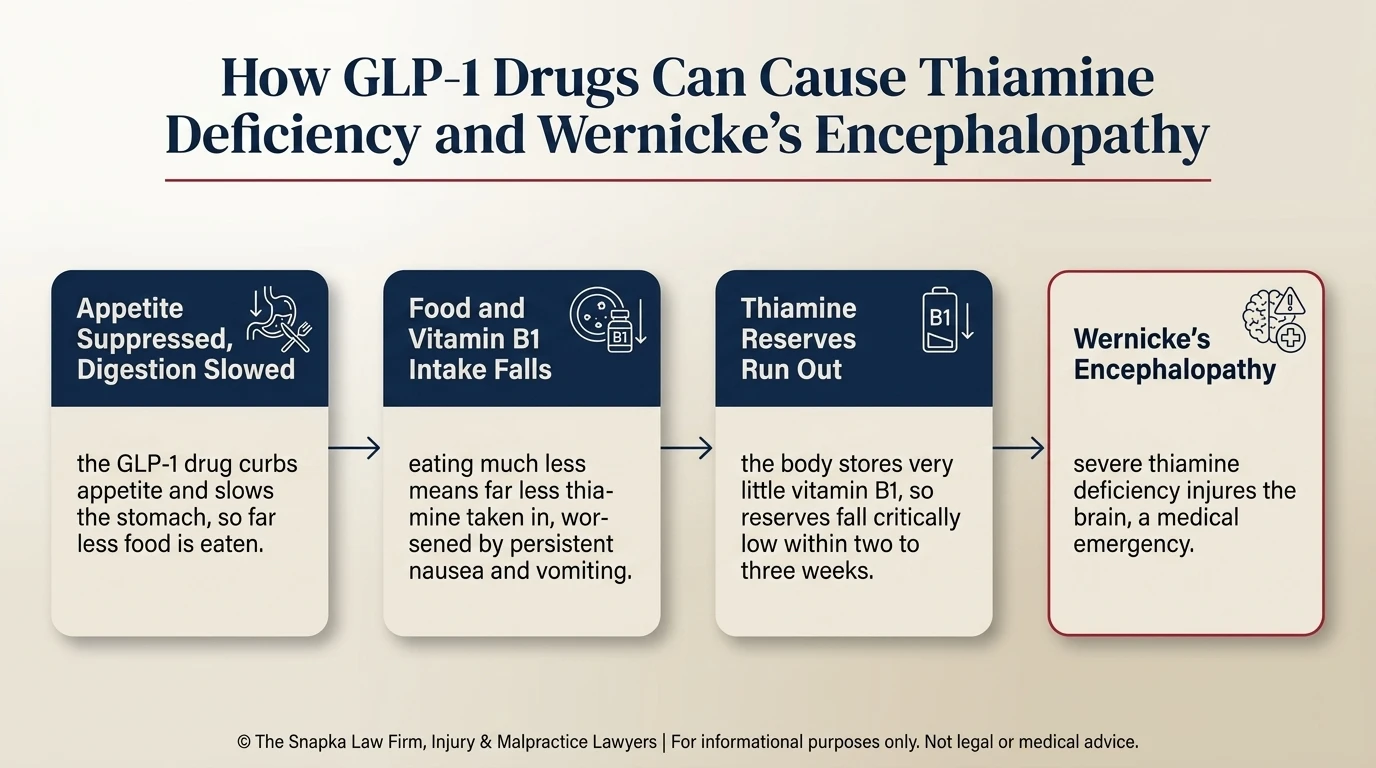
GLP-1 drugs can trigger thiamine deficiency by suppressing appetite and slowing digestion so effectively that patients stop taking in enough vitamin B1, especially when combined with the nausea and vomiting these drugs commonly cause.
When someone eats significantly less food over a sustained period, they take in fewer vitamins along with fewer calories. A 2026 narrative review published in the journal Clinical Obesity examined data from more than 480,000 adults on GLP-1 therapy and found that micronutrient deficiencies, including thiamine, were a common consequence of treatment rather than a rare or unusual side effect.
Thiamine is especially vulnerable to this kind of shortfall for the simple reason that the body can’t store much of it. Unlike some vitamins the body banks for weeks or months at a time, thiamine reserves typically run low within two to three weeks if intake drops.
Persistent nausea and vomiting, a well-documented side effect of GLP-1 drugs, compounds the problem further, since it can prevent the body from absorbing what little thiamine does make it into the diet. A Medscape review of GLP-1-related nutrition data confirms this pattern, noting that separate case reports have linked GLP-1 use to severe thiamine deficiency, including instances of both beriberi and Wernicke’s encephalopathy.
Put simply, rapid weight loss, reduced food intake, and persistent vomiting are a recipe for thiamine depletion. For a small number of patients, that depletion has progressed into a medical emergency.
Is There Scientific Evidence Linking GLP-1 Drugs to Wernicke’s Encephalopathy?
Yes. Multiple independently conducted studies published since 2025 show a statistically significant, disproportionate link between GLP-1 drugs and Wernicke’s encephalopathy, primarily driven by severe thiamine deficiency.
Pharmacovigilance Data on GLP-1 Drugs and Wernicke’s Encephalopathy
Three separate research efforts, using different databases and methods, converge on the same signal:
- Semaglutide (Ozempic®, Wegovy®): a reporting odds ratio of 10.2 in an analysis presented at the American Association of Clinical Endocrinology’s 2026 conference, later covered by the Cleveland Clinic Journal of Medicine
- Tirzepatide (Mounjaro®, Zepbound®): a reporting odds ratio of 11.4 in that same analysis
- The broader GLP-1 class: a reporting odds ratio of 2.37 for Wernicke’s encephalopathy among 19 distinct neurological safety signals identified in a pharmacovigilance study published in Scientific Reports, drawn from more than 28,000 adverse event reports in the FDA’s own database
Nearly every case in this body of research shares the same pattern beforehand; pronounced appetite suppression, persistent vomiting, and rapid weight loss.
A systematic review published in the journal Obesity documented individually confirmed cases of Wernicke’s encephalopathy in patients prescribed semaglutide specifically for weight loss, including one detailed in a related analysis in the European Journal of Clinical Nutrition involving a 49-year-old woman who developed the condition after weeks of vomiting and reduced food intake. That review recommends physicians begin high-dose thiamine treatment immediately in similar cases, without waiting for lab confirmation.
What This Research Does and Doesn’t Prove
These findings describe a consistent pattern rather than a single isolated incident. Appetite suppression and vomiting lead to rapid weight loss. Rapid weight loss leads to thiamine depletion, and in rare cases, that depletion leads to a preventable neurological emergency.
It should be noted that as of July 2026, these are only pharmacovigilance signals and case reports, not large randomized controlled trials, and the FDA has not issued a black-box warning specific to thiamine deficiency for any GLP-1 drug.
What this research does establish is a real, recurring pattern that treating physicians, and the people who prescribe these medications need to know about.
Wernicke’s Encephalopathy Symptoms in GLP-1 Users
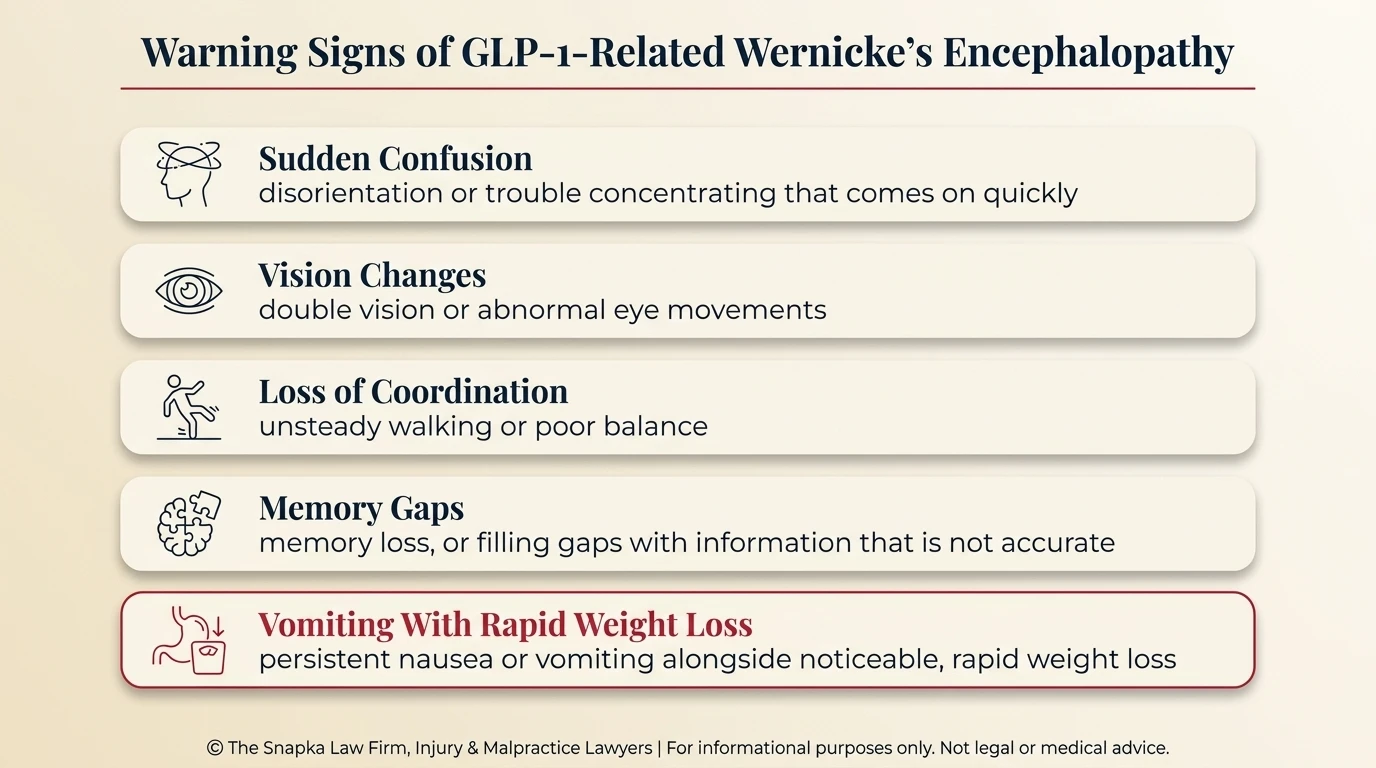
The most common early signs of GLP-1-related Wernicke’s encephalopathy are sudden confusion, vision changes, and problems with coordination or balance, though the full combination of all three rarely appears at once. If you or a loved one are taking a GLP-1 drug, watch for:
- Sudden confusion, disorientation, or difficulty concentrating
- Double vision, abnormal eye movements, or other vision changes
- Unsteady walking, poor coordination, or balance problems
- Memory gaps, or filling in memory gaps with information that isn’t accurate
- Persistent nausea or vomiting combined with noticeable, rapid weight loss
If you or a loved one notice any of these signs, especially alongside significant weight loss or ongoing vomiting, seek medical attention promptly. High-dose thiamine treatment is inexpensive, low-risk, and most effective when started right away, before waiting for lab-confirmed results, and if you’re uncertain whether your symptoms fit this pattern, that uncertainty alone is reason enough to get evaluated rather than wait it out.
Is There a GLP-1 Wernicke’s Encephalopathy Lawsuit?
Yes. Thousands of personal injury lawsuits against GLP-1 drug manufacturers have been consolidated into a federal multidistrict litigation, MDL No. 3094, that specifically lists Wernicke’s Encephalopathy among the injuries plaintiffs allege.
MDL No. 3094: The Federal GLP-1 Litigation
According to the court’s own case description, the litigation covers injury claims tied to Ozempic®, Wegovy®, Rybelsus®, Trulicity®, Mounjaro®, and related drugs. The Amended Master Complaint filed in that litigation lists Wernicke’s Encephalopathy by name among the injuries plaintiffs allege, alongside vitamin deficiency, gastroparesis, and other serious complications. The litigation names both major manufacturers, Novo Nordisk and Eli Lilly, and continues to grow as more patients come forward.
Independent Reporting Confirms the Pattern
USA Today’s review of federal and state lawsuits, published in 2026, profiled a Louisiana woman who vomited for weeks before being diagnosed with a brain dysfunction typically caused by a vitamin deficiency, one of thousands of plaintiffs the paper identified across at least 44 states.
None of this means that every case of Wernicke’s encephalopathy following GLP-1 use is legally actionable, and no attorney can promise a particular outcome before reviewing the facts of your specific situation. What it does mean is that this is a recognized, actively litigated pattern of injury, not a fringe theory, and that patients who experienced it are not alone.
How a GLP-1 Brain Injury Claim Differs from Stomach and Vision Claims
Most GLP-1 litigation to date concerns gastrointestinal injuries such as gastroparesis and bowel obstruction, and more recently a form of vision loss. A Wernicke’s encephalopathy claim is a different case built on different proof. The injury is neurological, the mechanism is nutritional depletion rather than direct organ damage, and the evidence lives in thiamine levels, MRI findings and the treatment timeline rather than in endoscopy or ophthalmology records.
The difference in injury also changes who the claim may be against. A gastrointestinal claim generally targets the drug manufacturer. A Wernicke’s encephalopathy claim can involve the manufacturer, the prescribing physician who did not monitor nutrition in a patient with persistent vomiting, or the hospital that treated the confusion without ever considering thiamine. Establishing which of those failures caused the permanent injury requires a firm that has litigated Wernicke’s encephalopathy specifically, not weight-loss drug cases generally.
Families searching for an Ozempic brain damage lawyer frequently find pages about stomach paralysis or vision loss instead. If the injury involved confusion, memory loss, unsteady walking or abnormal eye movements, the relevant condition is Wernicke’s encephalopathy, and the questions a lawyer needs to ask are entirely different.
Get the Help You Deserve! 844-848-8159
What to Do If You Suspect GLP-1-Related Wernicke’s Encephalopathy
The first step is always immediate medical evaluation, particularly if you or a loved one notice confusion, vision changes, or coordination problems alongside rapid weight loss or persistent vomiting while taking a GLP-1 drug. Don’t wait to see if symptoms resolve on their own, and ask specifically about checking thiamine levels; advocate for prompt treatment even before test results come back.
Document what happened. Keep track of which GLP-1 drug you were prescribed, when you started taking it, your symptoms and when they began, and any hospitalizations or diagnoses that followed.
Consider reporting the reaction to the FDA’s MedWatch program, which collects real-world safety reports on medications like these directly from patients and healthcare providers. Doing so contributes to the broader safety picture, separate from and in addition to any legal claim you may wish to pursue.
Finally, consider speaking with an attorney experienced in GLP-1 and pharmaceutical litigation. A free consultation costs you nothing and can help you understand whether your situation fits the pattern being investigated nationally, and what your options may be.
Why Choose The Snapka Law Firm for Your GLP-1 Wernicke’s Encephalopathy Case
If you’re facing a Wernicke’s encephalopathy diagnosis tied to a GLP-1 drug, you deserve experienced representation from a legal team that knows this exact type of case, not one learning the medicine as it goes.
A Proven Track Record in Wernicke’s Encephalopathy Cases
Our attorneys have experience handling these cases as evidenced by real verdicts and settlements. The Snapka Law Firm secured a $14 million verdict for a bariatric surgery patient who developed Wernicke’s encephalopathy, plus several additional seven and eight-figure settlements in Wernicke-Korsakoff syndrome cases that remain confidential. Past results don’t guarantee a similar outcome in any future case, but few firms nationally can match this level of direct experience with Wernicke’s and Korsakoff-related litigation.
Led by Board-Certified Trial Attorney Kathryn Snapka
The Snapka Law Firm has spent more than 40 years dedicated to medical malpractice, pharmaceutical litigation, and serious injury cases throughout Texas and nationwide. We’re led by attorney Kathryn Snapka, board certified in both Personal Injury Trial Law and Civil Trial Law and named a Texas Super Lawyer every year since 2003. Our national reach means we take these cases wherever they arise, with free initial consultations and a willingness to go to trial when that’s what it takes.
Talk to a GLP-1 Wernicke’s Encephalopathy Attorney Today
If you or a loved one developed Wernicke’s encephalopathy after taking Ozempic®, Wegovy®, Mounjaro®, Zepbound®, or another GLP-1 drug, you don’t have to sort through the medical and legal questions alone. The Snapka Law Firm offers free, no-obligation consultations to help you understand what happened and what options you may have.
Contact us today to speak with an experienced member of our team about your situation.
Frequently Asked Questions
Is there a lawsuit for Ozempic® and Wernicke’s encephalopathy?
Yes. Wernicke’s Encephalopathy is named specifically in the Amended Master Complaint filed as part of MDL No. 3094, the federal multidistrict litigation covering Ozempic®, Wegovy®, Mounjaro®, and related GLP-1 drugs. Whether a specific case qualifies depends on individual facts, which is why a free consultation with an attorney matters.
Has the FDA issued a warning about GLP-1 drugs and Wernicke’s encephalopathy?
Not yet, at least not a black-box warning specific to thiamine deficiency. The current evidence comes from pharmacovigilance studies and individual case reports rather than a formal FDA safety communication on this exact complication, though the agency continues to monitor GLP-1 drugs through its Adverse Event Reporting System.
Is Wernicke’s encephalopathy reversible?
Often, when it’s caught early and treated promptly with high-dose thiamine, the acute symptoms of Wernicke’s encephalopathy can improve significantly. If the condition progresses to Korsakoff syndrome first, though, memory-related symptoms are frequently only partially reversible.
What organ is Ozempic hard on?
Ozempic most commonly affects the digestive system, causing nausea, vomiting and delayed stomach emptying. The brain is affected indirectly rather than directly. Prolonged vomiting and sharply reduced food intake can deplete thiamine, and thiamine depletion is what produces the neurological injury seen in Wernicke’s encephalopathy.
How do you feel when your thiamine is low?
Early thiamine deficiency usually feels like exhaustion, irritability, poor appetite and a vague mental fog that patients often attribute to the diet or the medication itself. Numbness or burning in the hands and feet can follow. Confusion, double vision and unsteady walking mark the point at which deficiency has become a neurological emergency rather than a nutritional complaint.
How long does it take to fix thiamine deficiency?
Thiamine levels themselves can be restored within days once high-dose intravenous thiamine is started. Whether the brain recovers is a separate question and depends almost entirely on how quickly treatment began. Eye movement problems often improve within hours to days, unsteady walking improves more slowly and incompletely, and memory loss that has already set in is frequently permanent.
Can I take thiamine supplements with Mounjaro?
Thiamine supplementation alongside a GLP-1 drug is a question for the prescribing physician, and this page is not medical advice. What matters legally is that the risk is documented in the medical literature, which means a prescriber who ignores persistent vomiting and rapid weight loss in a GLP-1 patient is ignoring a known and published complication rather than an unforeseeable one.
Does Mounjaro or Zepbound (tirzepatide) carry the same risk as Ozempic®?
Based on current research, yes. Tirzepatide, the active ingredient in Mounjaro and Zepbound, showed a comparable or higher reporting odds ratio for Wernicke’s encephalopathy than semaglutide, the active ingredient in Ozempic® and Wegovy®, in recent pharmacovigilance studies. This appears to be a class-wide pattern rather than a risk unique to one brand.
What should I do if I suspect Wernicke’s encephalopathy from a GLP-1 drug?
Seek medical evaluation immediately, particularly if you’re experiencing confusion, vision changes, or coordination problems alongside significant weight loss or persistent vomiting. After the medical emergency is addressed, consider reaching out to an attorney to understand your legal options. A free consultation with our firm can help you figure out your next steps without any obligation.
Has The Snapka Law Firm handled Wernicke’s encephalopathy cases before?
Yes. The firm has secured a $14 million verdict in a Wernicke’s encephalopathy case involving a bariatric surgery patient, along with multiple confidential seven and eight-figure settlements in related Wernicke-Korsakoff syndrome litigation. This makes The Snapka Law Firm one of a small number of firms nationally with direct trial and settlement experience in this specific type of case.
Sources
- Mayo Clinic Proceedings, Wernicke Encephalopathy: Clinical Pearls
- Cleveland Clinic, Wernicke-Korsakoff Syndrome
- Frontiers in Endocrinology, Mechanisms of Action and Therapeutic Applications of GLP-1 and Dual GIP/GLP-1 Receptor Agonists
- U.S. Food and Drug Administration, Update on FDA’s Ongoing Evaluation
- Eli Lilly and Company, What to Know About Retatrutide
- Clinical Obesity, via PubMed, Micronutrient and Nutritional Deficiencies Associated With GLP-1 Receptor Agonist Therapy
- Medscape, What Nutrients Are GLP-1 Users Lacking?
- Cleveland Clinic Journal of Medicine, Wernicke Encephalopathy Emerges as a Possible Safety Signal in Patients on GLP-1 Receptor Agonists
- Scientific Reports, Pharmacovigilance Analysis of Neurological Adverse Events Associated With GLP-1 Receptor Agonists
- Obesity, Wernicke’s Encephalopathy Following Semaglutide Treatment for Obesity: A Systematic PRISMA Review
- European Journal of Clinical Nutrition, Semaglutide-Induced Wernicke Encephalopathy: A Comprehensive Analysis
- U.S. District Court, Eastern District of Pennsylvania, MDL 3094: In Re Glucagon-like Peptide-1 Receptor Agonists (GLP-1 RAs) Products Liability Litigation
- U.S. Courts, via govinfo.gov, Amended Master Long Form Complaint, MDL No. 3094
- USA Today, Weight-Loss Drugs Draw Thousands of Lawsuits Alleging Serious Harm
- Board Certified in Personal Injury Trial Law and Civil Trial Law, Texas Board of Legal Specialization
- Fellow, American College of Trial Lawyers
- Martindale-Hubbell AV Preeminent rated; Texas Super Lawyer since 2003
- Representing victims of medical negligence since 1982, with a national focus on Wernicke’s encephalopathy and Wernicke-Korsakoff syndrome